
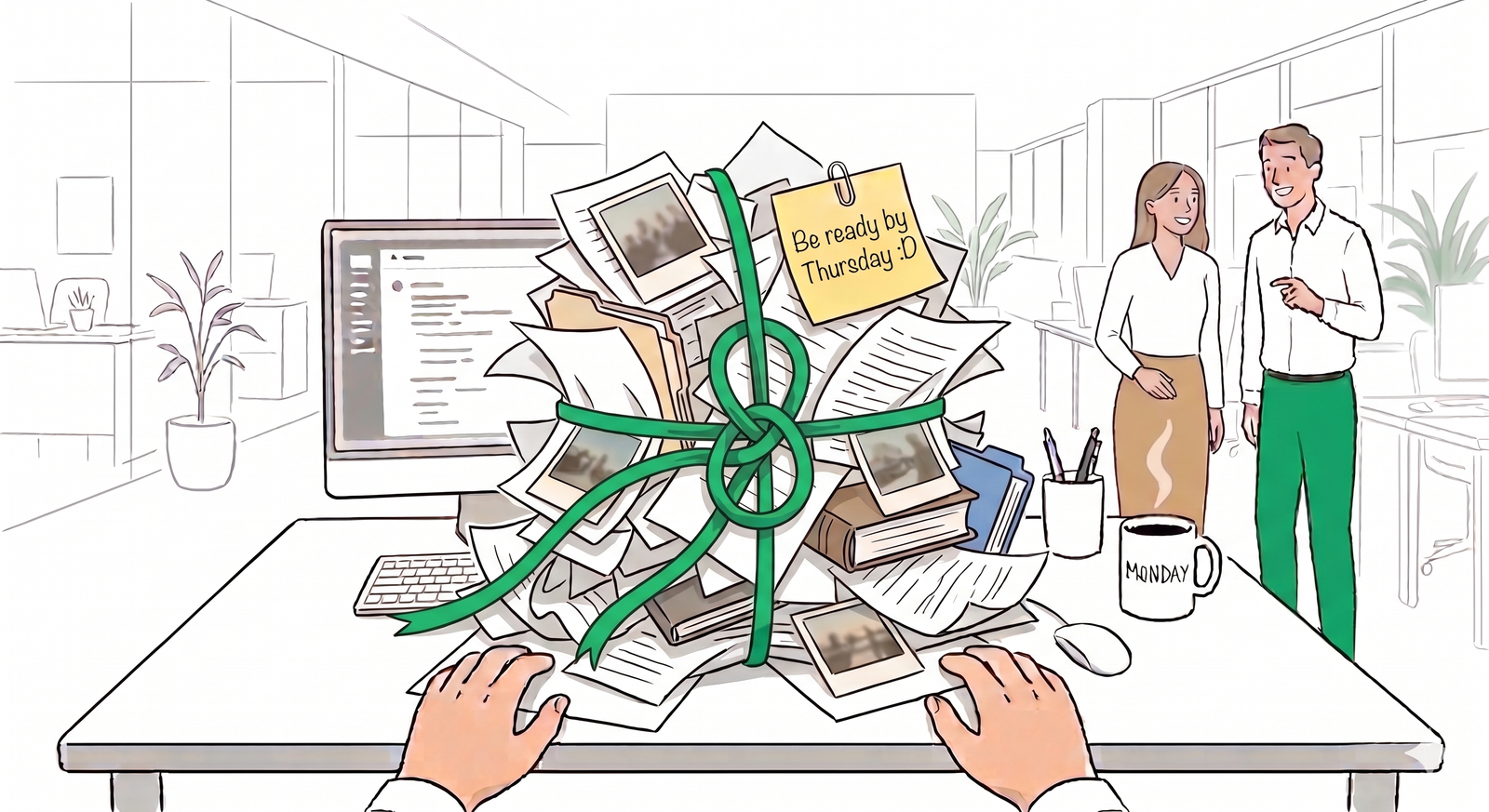
Turn raw context into live knowledge
New hire, new project, new client, new launch, cross-team move. Drop in your raw context, get an interactive protocol. You'll listen → drill → chat → test until it sticks. Own it by Thursday.
Not an LMS. Raw materials in. Start yesterday.
An LMS needs six weeks, an instructional designer, and a course author before anyone sits down to learn.
brainload needs your raw materials and a deadline. The protocol starts today.
Setup
What Day 0 actually looks like.
Both promise “training on your stuff.” The difference is where you are at the end of week one.
- Hire instructional designer
- Scope the course, write objectives
- Build curriculum (4–6 weeks)
- Configure SCORM / xAPI
- Publish, launch comms
- Hope someone takes it
- Drop raw materials (Notion, Drive, Slack, code, regs)
- Set the deadline
- Mentor-bot starts in Slack today
- 17 min/day, verified by day X
What we do
We don’t train people. We make sure they’re ready — by a specific day.
Most onboarding is “read and pray”: docs, calls, and hope it sticks. It doesn’t.
Built on proven learning science: spaced repetition and active recall.
Who it’s for
Anywhere people need to load context fast.
Project ramp-up
New client, new industry, new context. Project-ready in days, not weeks.
Employee onboarding
Replace the PDF + mentor-call grind. Verified completion, not assumed.
Sales enablement
New product, new territory. Reps actually retain the playbook.
Role transitions
Internal moves, succession, knowledge handover before someone leaves.
More: post-merger integration · compliance updates · pitch prep · crisis response.
How it works
Sandwich: AI → methodologist → AI.
Two layers of AI with a learning expert in the middle. AI scales. The human keeps the program honest.
Three layers, not one.
Your Slack threads, decision docs, customer calls, transcripts.
Adult learning principles, cognitive load theory, spaced repetition. Decides what to compress, what to drill, what to test.
This layer doesn’t exist in any foundation model.
Flashcards, audio at the right moment, scenarios in Slack, mastery test on day 7.
We use Claude, GPT, and ElevenLabs as infrastructure. The methodology is ours.
Ingest & map
AI reads your raw materials — wherever they live (Glean, Confluence, Notion, Google Drive, Slack, GitHub, or your on-prem stack) — and produces a structured knowledge base plus a menu of learning methods that fit this specific domain.
Methodologist designs the program
A learning expert picks methods, sets pace, defines pass criteria, and tunes the plan to the role and the deadline. Not a template — a real plan.
Run the loading protocol
AI assembles and delivers the protocol day by day. A mentor-bot runs short sessions in Slack or Teams — wherever the employee already works — consults on demand, and verifies knowledge with tests and free-form Q&A.
A foundation model answers your question.
brainload makes your team ready by Thursday.
Works with your stack
Plugs into where your knowledge already lives.
Glean · Confluence · Notion · Google Drive · SharePoint · Slack · GitHub · your on-prem store.
Read-only via your existing permissions. Cloud or on-prem deployments. No data migration.
Real example
Onboarding a junior analyst on a new regulatory domain.
A real case: MiFID II compliance, after the €100,000 Wonderinterest fine (Dec 2025). All three sandwich stages spelled out.
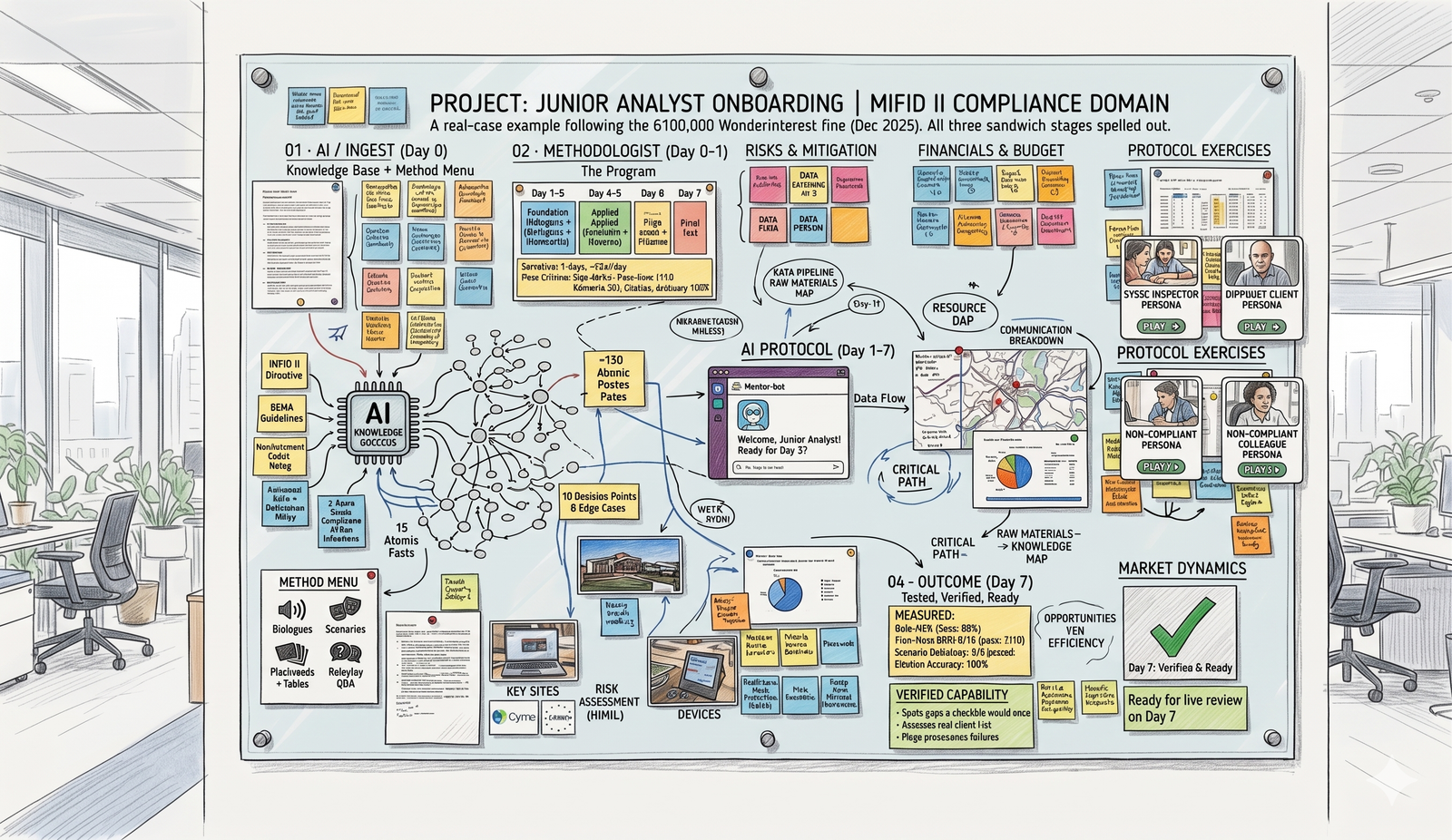
Knowledge base + method menu
AI processes raw materials and produces a structured knowledge map of the domain, plus a menu of learning methods that fit it.
- MiFID II directive + ESMA guidelines
- Wonderinterest CySEC ruling
- 4 internal SOPs + governance policy
- 2 hours of senior compliance officer interviews
- knowledge map: ~120 atomic facts
- 18 decision points + 9 edge cases
- method menu: dialogues, scenarios, flashcards, roleplay, free-form Q&A
- every fact cited back to the source
The program
A learning expert reviews the AI output, picks methods, sets pace, defines pass criteria, and tunes the plan to the role and the deadline.
- 7 days, ~45 min/day
- Day 1–3: foundation — dialogues + flashcards
- Day 4–5: applied — scenarios + roleplay
- Day 6: edge cases + free-form Q&A practice
- Day 7: final test + live-review readiness
- quiz: 85%+
- free-form Q&A: 7/10 on rubric
- scenario roleplays: 3/3 passed
- can cite source on any decision
Mentor-bot in Slack runs the protocol
AI assembles and delivers the daily protocol. The mentor-bot meets the employee in Slack — short sessions wherever convenient. Its job: prepare and verify.
- 4 × 6–8 min audio dialogues, commute-friendly
- ~10 flashcards/day, spaced repetition
- 2 progressive quizzes (Day 3, Day 5)
- 3 scenario roleplays: bot plays a CySEC inspector, a difficult client, a sales colleague pushing a non-compliant product
- free-form Q&A: employee answers in their own words; bot grades against a rubric and returns feedback
- on-demand consult: “what does ESMA say about X?” — bot answers from the knowledge base, with citation
- delivers sessions in Slack/Teams — where the employee already works
- tracks completion and recall over time
- spots weak spots, schedules extra reps
- evaluates free-form answers, not just multiple choice
- flags the methodologist if the employee is off-track
Tested, verified, ready.
Not signed-off — actually verified. Numbers and capability, not just a completion certificate.
- quiz: 92% (pass: 85%)
- free-form Q&A: 8/10 (pass: 7/10)
- scenario tests: 3/3 passed
- citation accuracy: 100%
- spots gaps a checklist would miss
- assesses real client risk in own words
- flags governance failures with rationale
- ready for live review on Day 7
Why us
Built on proven systems.
This is our third application of the same learning engine. The same primitives that drive measured language retention and certified medical training, now turned on corporate knowledge.
Greek language A2 in weeks, not years. Spaced repetition, AI dialogues, real comprehension tests. The pedagogical engine.
Certified pediatric medical protocols with AI-assisted video analysis. The rigour: medical-grade verification, real patient outcomes.
Proof
Numbers, not vibes.
Ebbinghaus forgetting curve
Cepeda 2008 (n>14k) / Karpicke 2011
First design-partner pilots run summer 2026. Per-cohort results published. Design partners see the numbers first.
Test brainload protocol with my context
Free pilot — limited spots
Drop your context. Get a working protocol back.
Tell us what you need to load — new role, new project, new regulation, anything — and share the raw materials. We’ll build you a free test loading protocol on it: an interactive plan tuned to your case.
- Audio podcasts — commute-friendly dialogues on your material
- Flashcards — spaced-repetition deck of the atomic facts
- Scenario quizzes — applied roleplays, not multiple choice
- Final test — verifies you actually loaded it, free-form Q&A graded against a rubric
- Direct founder feedback after you run through it
Turnaround under a week. We reply within 24 hours.
Questions
Honest answers to the obvious objections.
Won’t OpenAI or Anthropic build this?
Foundation labs are brilliant at answering questions. But shaping a learning protocol for a real person — what to compress, what to drill, when to push, when to back off — needs a human who can read the situation.
That’s our architecture: human-in-the-loop. The AI scales delivery; the methodologist keeps the program honest for this person, on this deadline.
The labs have models. We have learners.
Why not just build a custom GPT on our docs?
A custom GPT is a search interface — it answers what you ask.
brainload sequences a protocol for a specific person learning a specific thing by a specific date. Picking the right mix — audio on the commute, flashcards in 5-minute windows, scenarios in Slack, mastery test on day 7 — requires reading the human, not just the docs.
Our methodologist makes those calls. The AI executes them.
Are you a wrapper around GPT?
The model is one of three layers. The other two — human-in-the-loop methodology and outcome verification — are most of the value, and all of the IP.
What our human brings is years of working directly with learners:
- listen.talk — what actually works with adult language learners (and what doesn’t, no matter how clever the prompt)
- scanchild.eu — certified pediatric medical training: zero-error tolerance, real outcomes
- Katya runs Feldenkrais Method trainings — deep work with attention, neuro-patterns, and how the body and mind actually learn
We use foundation models the way Stripe uses banks. Infrastructure, not product.